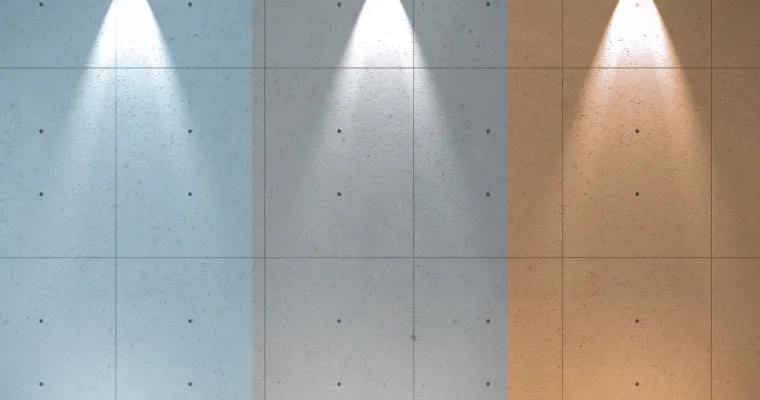

Color-rendering properties of light sources
Light color, the color of the light source, and color-rendering properties, which are the characteristics of the illumination light that affect the way the color of an object is seen, change according to the proportion or ratio of the composition of the components of each wavelength of each ray of light emitted by the light source. Light color affects the ambience of a space, and color-rendering properties affect how the color of an object is seen. For this reason, one must give full consideration to not only the luminance level and brightness distribution but also light color and color-rendering properties in order to create a comfortable lighting environment.
1. Color-rendering properties
In general, the color of an object tends to be regarded as being unique and inherent to that object. However, when the object is illuminated with light of a different composition (spectral distribution), it appears to be a different color. Light source properties that affect the perception of the color of an object are called color-rendering properties. Accordingly, light sources with good color-rendering properties generally refer to light sources with good properties for seeing color. Color-rendering is one of the most important characteristics of lighting light sources.
Quantitatively evaluating a light source's color-rendering properties is important for objectively determining the advantages and disadvantages of color-rendering properties and selecting the required light source. Overall, there are two methods for quantitatively evaluating these color-rendering properties. The first is the method for evaluating color appearance fidelity, and the other is the method for evaluating color appearance desirability. With the method for evaluating color appearance fidelity, the subject light source is compared to the light source that serves as the standard (standard light source) and quantitatively evaluated to determine how faithfully the color is reproduced. In contrast, with the method for evaluating color appearance desirability, a color shift occurs when the subject light source is compared to the standard light source, and so the color shift is quantitatively evaluated to determine whether the shift is in a desirable or an undesirable direction.
Both of these evaluation methods are important in the evaluation of a light source’s color-rendering properties, but to date, the only methods for evaluating color appearance fidelity have been standardized and established by the International Commission on Illumination (CIE) and in Japan the Japanese Industrial Standards (JIS). Thus far, several methods for evaluating color appearance desirability have been proposed, but no standardized method has been established. For this reason, the following section introduces the JIS method for evaluating color appearance fidelity.
2. CIE methods for evaluating color-rendering properties
Up until now, many tests attempting to quantitatively evaluate the color-rendering properties of light sources have been conducted; however, the most broadly used test nowadays is the color-rendering properties evaluation method established by the CIE. In 1965, the CIE published the first edition of their Method of Measuring and Specifying Colour Rendering Properties of Light Sources [1]. Subsequently, the CIE partially revised the first edition of their evaluation method in 1974 and published their second edition [2]. In 1995, typographical errors in the second edition were corrected and the third edition was published [3].
For evaluating color appearance fidelity, 14 types of test colors are used, and an evaluation is carried out using the method explained below. In short, to evaluate the color-rendering properties of a certain light source using 14 types of test colors, the color appearance when an object is illuminated by that light source is then compared to the color appearance when the object is illuminated with a standard light source with the equivalent color temperature to that of the subject light source, and the color-rendering properties of the subject light source are expressed by the size of the color shift (color difference:ΔE).
The average color rendering index (CRI) expresses the average (ΔE) color shift on individual color charts, each comprising 8 out of the 14 test colors of the colors (hues ranging from shades of red to shades of purple) (ΔEi;i=1–8) with medium vividness (Munsell chroma 4 – 8) and equivalent brightness (luminosity) (Munsell value 6), and is calculated using the following formula:
CRI=100−4.6ΔE……………(1)
The other seven test colors comprise color charts that are used when finding the special color rendering index Ri (i=9–14): a representative color chart comprising extremely vivid reds, yellows, greens, and blues (No. 9 to No.12); a color chart for Caucasian skin tones (No.13), and a color chart of greens close to the color of leaves (No.14). The special color rendering index Ri expresses the extent of the color shift for each of the individual test colors (ΔEi;i = 9 – 14) and is calculated using the following formula.
Ri=100−4.6ΔEi……………(2)
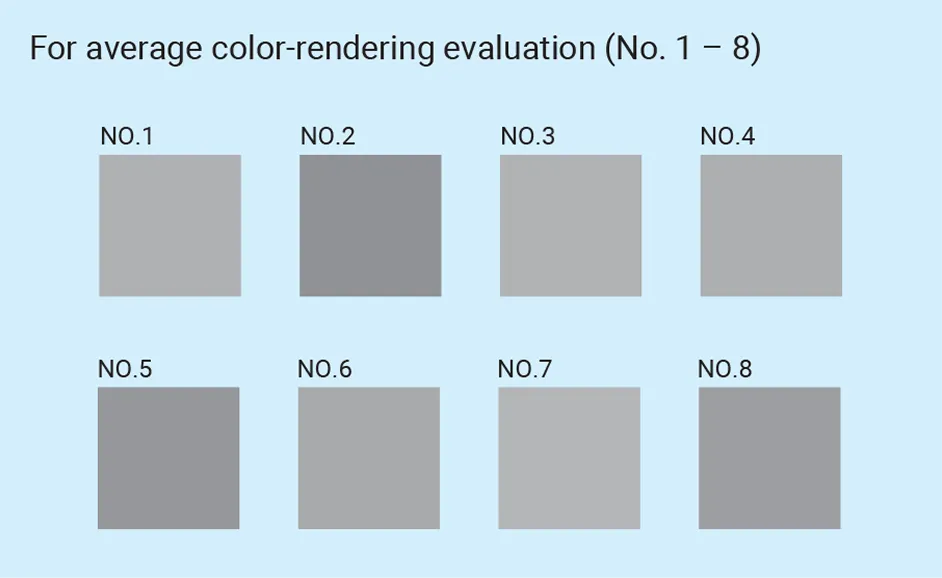
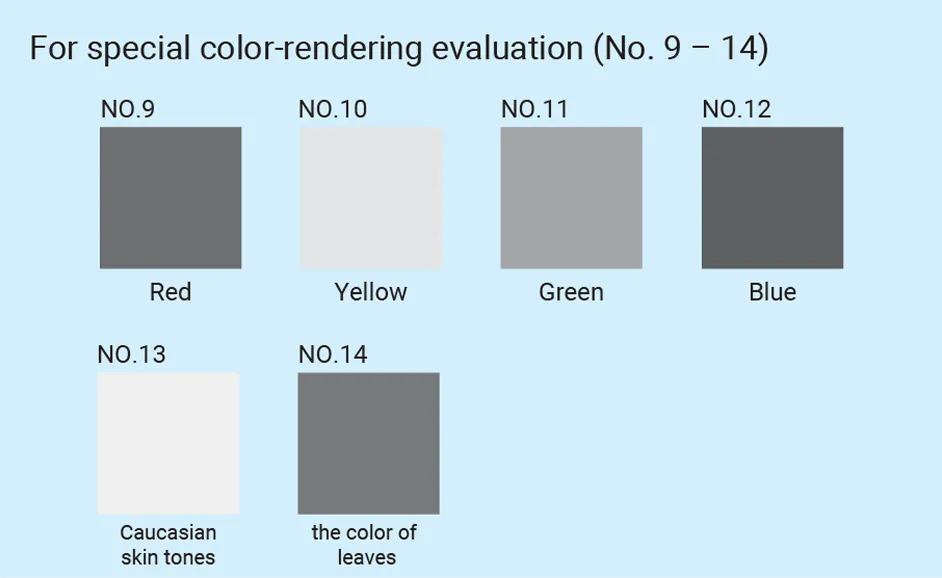
Fig. 3 shows the color charts for the eight test colors used to calculate the average color rendering index, and Fig. 4 shows the color charts for the six test colors used to calculate the special color rendering index. In addition, representative light source color rendering indexes calculated on the basis of the CIE’s method for evaluating color-rendering properties are provided in Table 1.
So that they can be derived using Formula (1) and Formula (2), the average color rendering index CRI and the special color rendering index Ri both have a numerical value of 100 when the color appearance of the subject light source is the same as the color appearance of the standard light source. The more the color appearance between the two differs, the greater the color difference ΔE becomes, and the color rendering index may have a negative value depending on the light source. However, it is not the case that the light sources for which the color rendering index has a negative value appear completely colorless. For example, the special color rendering index R9 (vivid red test colors: No.9) for a white fluorescent lamp has a value of around minus 100, but the light source still appears red, albeit a slightly dull reddish hue.
When using methods for evaluating such color-rendering properties as this, serious misunderstandings can arise simply because the calculated results are expressed as numerical values and if the kind of principle on which the evaluation method is based is not well-understood.
3. Meaning of and issues with the color rendering index
a. The color rendering index quantitatively expresses the fidelity of the color appearance of the subject light source compared to the standard light source. Accordingly, there is a possibility that a fair evaluation will only be obtained when it is being used for purposes requiring an evaluation of color appearance fidelity, such as a color comparison or a color inspection.
b. The color rendering index is not an index for expressing the degree of color appearance desirability of an object. Because the CRI value quantitatively expresses the size of the color shift for the subject light source compared to the standard light source, the CRI value will decrease regardless of whether the color shift is in a desirable or an undesirable direction. Accordingly, it is not possible to determine whether or not the color can be made to appear desirable on the basis of the size of the CRI value. For example, in terms of human facial colors, a slightly pink color shift from the usual skin color is desirable, but a yellow or green shift is seen as extremely unpleasant. The color rendering index is calculated with complete disregard for whether the color shift is desirable or unpleasant, and so even if the color rendering index value is the same, the practical value is completely different.
c. The light source color-rendering properties expressed by the average color rendering index CRI and special color rendering index Ri values quantitatively show the difference in color appearance between the subject light source and the standard light source with the same color temperature as the subject light source. For this reason, it is meaningless to, for example, compare the size of the color rendering indexes for two light sources with different color temperatures and strictly compare or evaluate the advantages and disadvantages of the color-rendering properties of the two light sources. For example, incandescent light bulbs with a color temperature 2800 K and natural daylight with a color temperature of 6500 K both have a CRI value of 100, but their color appearances are different.
d. For light sources that have a low average color rendering index CRI, for example, 60 or below, even if the color temperature is the same, it is impossible to strictly compare the advantages and disadvantages of the color-rendering properties of the light sources based on CRI size. The CRI expresses the average color shift for each of eight different test colors. Accordingly, say for example there are two light sources with a CRI of 50, the first light source has a color shift of 50 for all eight test colors, while the other light source scores range from 100 to zero depending on the test colors used. Naturally, the actual color appearances of the two light sources will differ. However, in the case of two light sources characterized by a CRI 80 or higher, the color rendering index for each of the eight test colors needs to have a high value, so when the color temperature and the chromaticity of the two light sources are virtually equal, they are both regarded as having high color-rendering properties.
e. The value color difference ΔE = 1.0 expresses a difference in the colors of two objects that general observers can barely distinguish. Accordingly, to enable the color difference to be found using the formula for calculating the color rendering index shown above (Formula (2)), the significant difference in practical terms for the color rendering is said to be around 5.0. If the color difference for the color rendering index is more detailed than this value, in practical terms, it is meaningless to discuss the pros and cons of a light source’s color-rendering properties.
When we consider the above points, it is thought that several restrictions need to be applied when using the color rendering index. For this reason, the CRI method for evaluating color-rendering properties is a scale with only a limited range for knowing a light source’s color appearance, and care needs to be taken when discussing the advantages and disadvantages of the color-rendering properties based solely on the size of the numerical values.
(References)
*The information on this page was formatted on the basis of our company’s Japanese language website and revised in accordance with IEC standards; however, some items have been formatted in accordance with JIS standards for reference.
1) Publication CIE No.13:Method of measuring and specifying colour rendering properties of light sources-1st edition (1965)
2) Publication CIE No.13.2:Method of measuring and specifying colour rendering properties of light sources-2nd edition (1974)
3) Publication CIE No.13.3:Method of measuring and specifying colour rendering of light sources (1995)