
Evaluation of the visual environment
Importance of an evaluation of the visual environment based on brightness
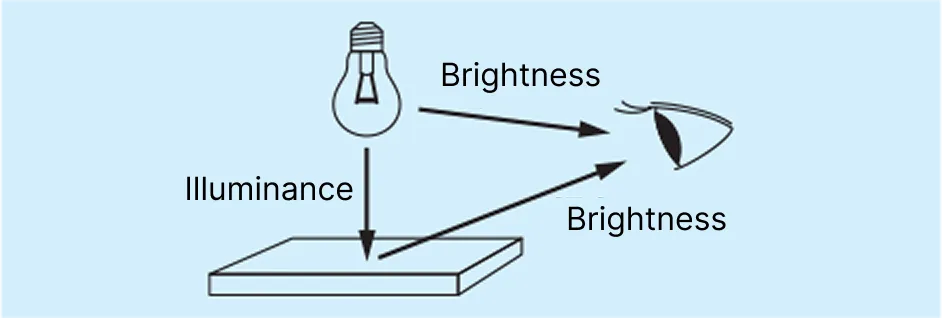
As was discussed in the chapter on luminous flux, illuminance is a very important evaluation index for lighting design with the majority of lighting designs based on the recommended illuminance stipulated by the CIE and other standards. Although illuminance can be measured with an illuminance meter, the photometric quantities that we can measure include not only illuminance but also brightness. Fig. 1 shows the relationship between illuminance and brightness.
As shown in Figure 1, Illuminance captures the light that enters the subject of the evaluation. However, when we consider the positional relationship between the eyes of the evaluator and the subject of the evaluation, the evaluation of brightness perceived by the evaluator regarding the subject is not based on the light entering the subject but rather on the amount of light coming in the direction of the evaluator’s line of sight after entering and then being reflected off the subject. If the subject itself emits light, such as a light source, the amount of light coming from the subject in the line of sight direction affects how people looking at the subject evaluate glare.
Brightness captures the amount of light coming towards the direction of the evaluator’s line of sight. Accordingly, in order to design lighting that considers human senses, the lighting design needs to be based more on brightness than illuminance.
In this chapter, we will introduce visual environment evaluation methods that were developed on the basis of brightness as described above.
Evaluation of visibility
When there is an illuminated lamp or window within a person’s field of view during the daytime, the glare will cause the person to feel uncomfortable, and the glare will make it difficult for the person to see the object. This phenomenon is called glare.
Usually, glare occurs when a person looks directly at a high-brightness lamp or other similar light source, but even when the person is not looking directly at the high-brightness lamp, the glare phenomenon can occur if the lamp is within the field of view, or if the lamp is reflected in glass or another shiny surface and its reflection enters the person’s eyes.
Also, glare is classified into two types depending on how it affects people: discomfort glare, which makes people uncomfortable, and disability glare, which makes it difficult for the person to see the object. In general, however, these two types of glare affect each other in complex ways, and they cannot easily be separated.
With general interior illuminance, there are very few cases in which the glare is at a critical level where the object the person is attempting to look at may or may not be visible, and there is sufficient leeway for the object to be seen. Thus, even if a light source with a slightly high brightness level enters a person’s field of view, major issues caused by disability glare almost never occur. For this reason, discomfort glare is the priority for interior lighting.
Up until now, many experimental studies have been carried out regarding methods for quantitatively evaluating the discomfort caused by the glare from lighting fixture. These evaluation methods can be broadly divided into the glare index system and the brightness control system.
1. Unified Glare Rating (UGR)
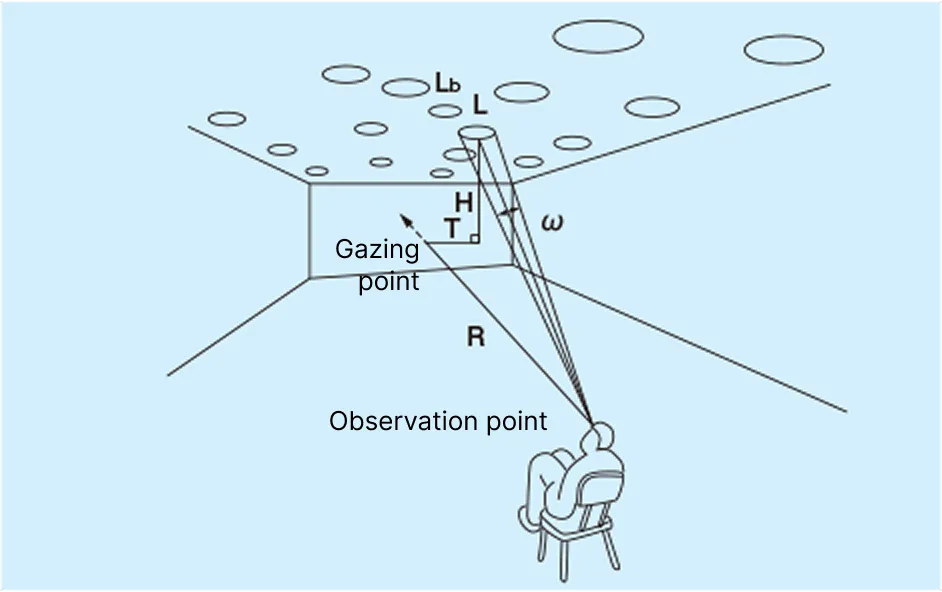
Table 1: Excerpt from the position index calculation table 1)
| H/R | ||||||||||
|---|---|---|---|---|---|---|---|---|---|---|
| 0.0 | 0.1 | 0.2 | 0.3 | 0.4 | 0.5 | 0.6 | 0.7 | 0.8 | ||
| T/R | 0.0 | 1.00 | 1.26 | 1.53 | 1.90 | 2.35 | 2.86 | 3.50 | 4.20 | 5.00 |
| 0.1 | 1.05 | 1.22 | 1.46 | 1.80 | 2.20 | 2.75 | 3.40 | 4.20 | 5.00 | |
| 0.2 | 1.12 | 1.30 | 1.50 | 1.80 | 2.20 | 2.66 | 3.18 | 4.20 | 5.00 | |
| 0.3 | 1.22 | 1.38 | 1.60 | 1.87 | 2.25 | 2.70 | 3.25 | 4.20 | 5.00 | |
| 0.4 | 1.32 | 1.47 | 1.70 | 1.96 | 2.35 | 2.80 | 3.30 | 4.20 | 5.00 | |
| 0.5 | 1.43 | 1.60 | 1.82 | 2.10 | 2.48 | 2.91 | 3.40 | 4.20 | 5.00 | |
| 0.6 | 1.55 | 1.72 | 1.98 | 2.30 | 2.65 | 3.10 | 3.60 | 4.20 | 5.00 | |
| 0.7 | 1.70 | 1.88 | 2.12 | 2.48 | 2.87 | 3.30 | 3.78 | 4.20 | 5.00 | |
| 0.8 | 1.82 | 2.00 | 2.32 | 2.70 | 3.08 | 3.50 | 3.92 | 4.20 | 5.00 | |
| 0.9 | 1.95 | 2.20 | 2.54 | 2.90 | 3.30 | 3.70 | 4.20 | 4.20 | 5.00 | |
| 1.0 | 2.11 | 2.40 | 2.75 | 3.10 | 3.50 | 3.91 | 4.40 | 4.20 | 5.00 | |
| 1.1 | 2.30 | 2.55 | 2.92 | 3.30 | 3.72 | 4.20 | 4.70 | 4.20 | 5.00 | |
| 1.2 | 2.40 | 2.75 | 3.12 | 3.50 | 3.90 | 4.35 | 4.85 | 4.20 | 5.00 | |
| 1.3 | 2.55 | 2.90 | 3.30 | 3.70 | 4.20 | 4.65 | 5.20 | 4.20 | 5.00 | |
| 1.4 | 2.70 | 3.10 | 3.50 | 3.90 | 4.35 | 4.85 | 5.35 | 4.20 | 5.00 | |
| 1.5 | 2.85 | 3.15 | 3.65 | 4.10 | 4.55 | 5.00 | 5.50 | 4.20 | 5.00 | |
| 1.6 | 2.95 | 3.40 | 3.80 | 4.25 | 4.75 | 5.20 | 5.75 | 4.20 | 5.00 | |
| 1.7 | 3.10 | 3.55 | 4.00 | 4.50 | 4.90 | 5.40 | 5.95 | 4.20 | 5.00 | |
The glare index system is a method for accurately evaluating the degree of discomfort glare using a calculation formula with the following variables: brightness of the light source that affects the level of discomfort glare, size of the light source; position of the light source, and the surrounding brightness forming the background for the light source’s light emitting surface (ceiling/wall surface etc.). In the past, several countries have independently formulated and used calculation formulas for this system.
Consequently, in 1987, the CIE set up a technical committee charged with the task of establishing a unified glare index system. Technological deliberations were carried out regarding the UGR (Unified Glare Rating)2)—a method that unified CIE discomfort glare—and the UGR was established as the CIE’s standard.
The UGR is calculated from the background brightness Lb[cd/m2], brightness of the light-emitting surface of the lighting fixture L[cd/m2], size of the lighting fixture’s light-emitting part ω[sr], and Guth’s position index p using Formula (3) shown below.

Here, the background brightness Lb is usually calculated using Formula (4) from the indirect illuminance Ei[lx] from the position of the observer’s eyes.

The brightness L of the lighting fixture’s light-emitting surface is found using Formula (5) from the lighting fixture’s observer-direction luminous intensity integral I[cd] and the projected area of the lighting fixture’s light-emitting part Ap[m2].

Because the size of the lighting fixture’s light-emitting part ω is expressed by a solid angle, it is calculated using Formula (6) shown below from the projected area of the lighting fixture’s light-emitting part Ap[m2] and the distance from the observer to the center of the lighting fixture’s light-emitting part r[m].

Guth’s position index p is determined by the position of the lighting fixture when seen by the observer. We will explain the method for finding this value using the lighting space example shown in Figure 10. As you can see in Figure 10, the positional relationship between the observer and the lighting fixture is expressed using H, T, and R. Next T/R and H/R are calculated from H, T, and R, and then p is interpreted from T/R and H/R.
Using the UGR calculated in this way, the discomfort glare in the subject facility is evaluated, or rather lighting fixture is selected. The relationship between the UGR value and the level of discomfort glare when these are carried out is as shown in Table 2, and so evaluations are carried out based on this table.
Table 2: Relationship between the UGR value and the level of discomfort glare 2)
| UGR level | ||||||
|---|---|---|---|---|---|---|
| 28 | 25 | 22 | 19 | 16 | 13 | |
| Glare level | Beginning to feel intolerable | Uncomfortable | Beginning to feel uncomfortable | Bothersome | Beginning to feel bothersome | Can be felt |
Table 3: Excerpt from the CIE’s list of lighting requirements
| Type of area | Specific tasks | Ēm lx (Required~Modified) | CRI | UGR |
|---|---|---|---|---|
| Office | Writing, Typing, Reading data processing | 500~1000 | 80 | 19 |
| Hotel | Reception/ cashier desk, porters desk | 300~500 | 80 | 22 |
| Conference room | 500~1000 | 80 | 19 | |
| Buffet | 300~500 | 80 | 22 | |
| Logistics and Warehouses | Unloading/ Loading area | 200~300 | 80 | 25 |
| Packing/ Grouping area | 300~500 | 80 | 25 | |
| General areas inside buildings | Canteens and break areas | 200~500 | 80 | 22 |
| Resting areas | 100~200 | 80 | 22 | |
| Rooms for physical exercise | 300~500 | 80 | 22 |
(References)
*The information on this page was formatted on the basis of our company’s Japanese language website and revised in accordance with IEC standards; however, some items have been formatted in accordance with JIS standards for reference.
1) Mori, Sudo, Saijo, Sato, and Hotta: Investigation of atmosphere evaluation index for architectural exteriors—second report, Proceedings of the annual conference of the illuminating engineering of Japan, pp. 5-23 (2012)
2) CIE Technical Report 117-1995: Discomfort Glare in Interior Lighting (1995).