

Beam angle
Beam angle refers to the degree to which the light emitted by a lighting fixture spreads and is measured as an angle. It indicates the degree of light concentration of spotlights and downlights.
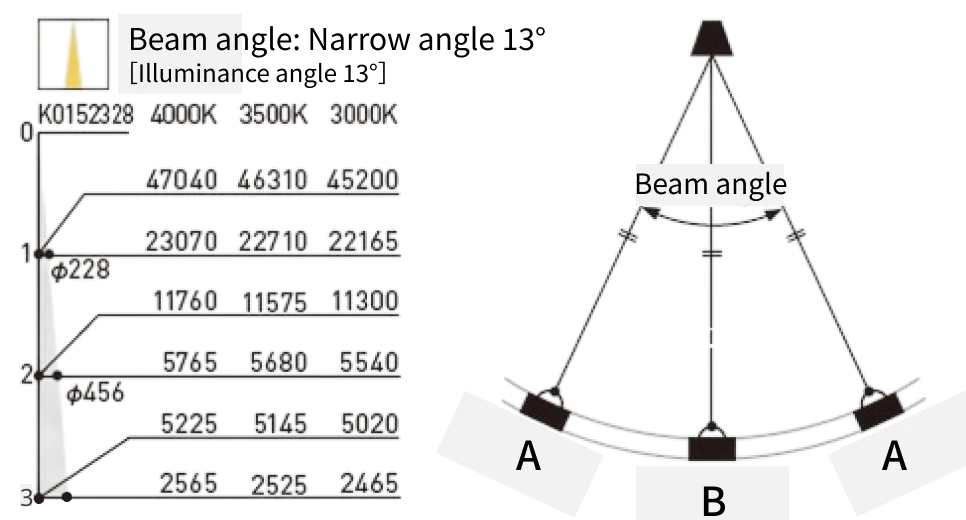
- A: 1/2 the luminous intensity of the central luminous intensity
- B: Central luminous intensity
*Compiled based on products made for use in Japan.
Beam angle basic concept
- The illuminance directly below the lighting fixture (central line) is the brightest (central luminous intensity*).
- The greater the distance from directly underneath the lighting fixture, the more the light diffuses, and the brightness gradually decreases.
- The sum of the angles formed by connecting the points on either side where the luminous intensity drops to one-half (50%) of the peak value.
The point at which the luminous intensity drops to one-half (50%) is also called the 1/2 beam angle.
*Luminous intensity: The level of brightness emitted by a light source in a certain direction. The unit of measure is the candela (cd).
(Supplementary explanation)
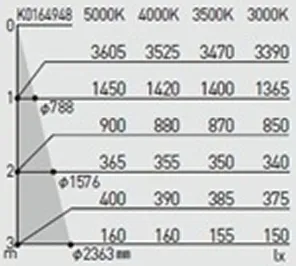
The light distribution information provided above shows the illuminance (lx) for each height from directly below the lighting fixture (on the centerline) and the illuminance (lx) at the point where the beam angle becomes 13° (1/2 the luminous intensity) at the same height.
Even when lighting fixtures have the same brightness, the brightness of the target object changes depending on the beam angle. Please refer to the following when selecting lighting fixtures.
- Narrow beam angle → The light converges at a single point, brightly illuminating and fully emphasizing the target object.
- Wide beam angle → Although a wide area can be illuminated evenly, illuminance directly below the lighting fixture (on the centerline) is reduced because of light diffusion.
| Light distribution angle |
 Beam angle: Narrow angle 12° [Illuminance angle 12°] |
 Beam angle: Medium angle 20° [Illuminance angle 18°] |
 Beam angle: Wide angle 34° [Illuminance angle 28°] |
 Beam angle: Wide angle 43° [Illuminance angle 33°] |
|---|---|---|---|---|
| Light distribution image |
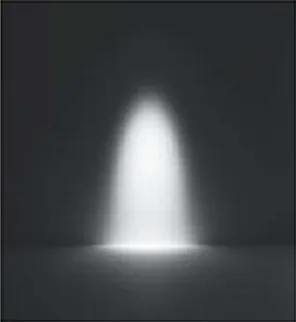 |
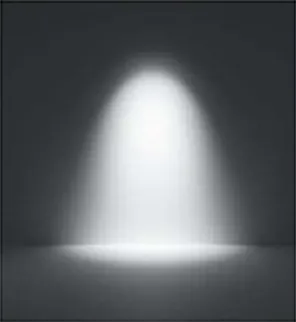 |
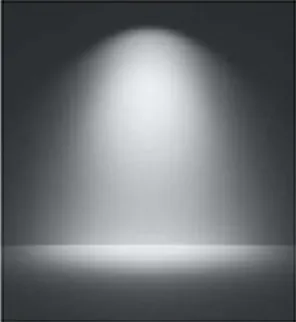 |
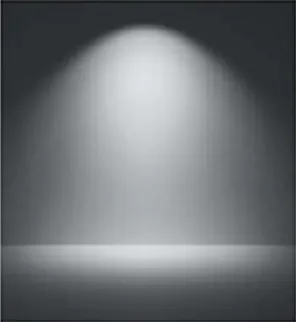 |
| LED 500 type |
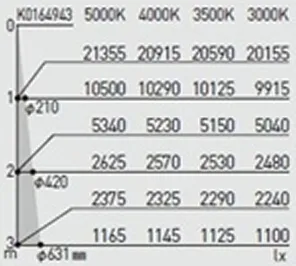 |
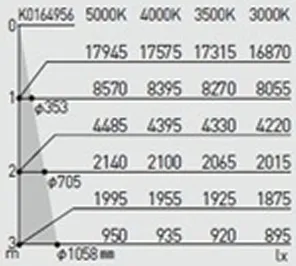 |
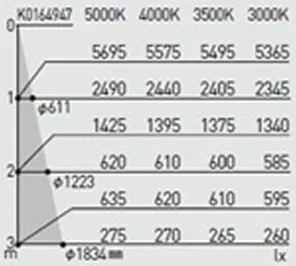 |
 |
Light distribution images and illuminance examples for each beam angle
*In the case of Japan-produced catalog data
■Beam angle of floodlights
A 1/10 beam angle is often used for floodlights that illuminate over long distances using high power output. Because a 1/10 beam angle clearly shows the area actually illuminated by the floodlights, it is widely used in building and sports lighting designs.

